
Balenciaga Luxury Brands Collection

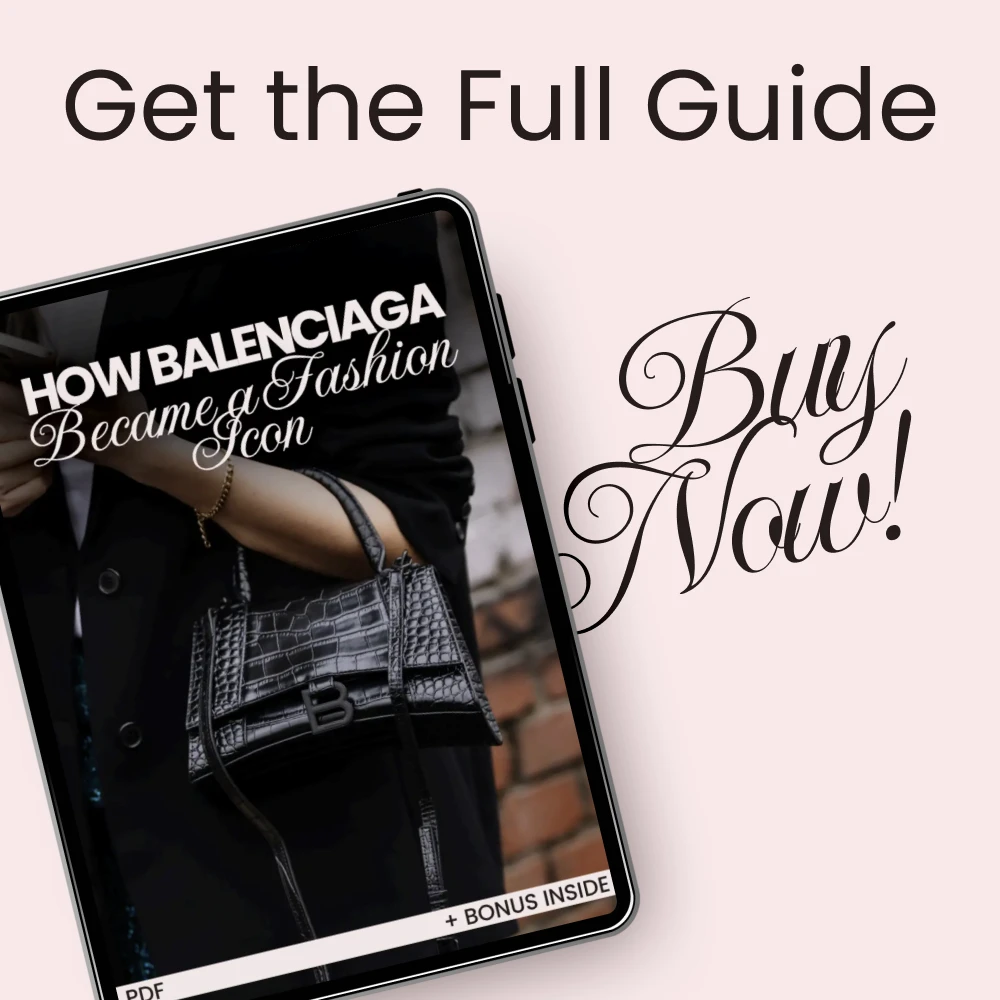
How Balenciaga Became a Fashion Icon – balenciaga brand history explained | Luxury Fashion Case Study eBook for Designers & Students

4.8 60 reviews 8,650 sold
Selling fast - 63 people bought this in the last 24 hours
Popular right now - 334 people are viewing this product
Top rated - 4.8 stars from 8650 verified buyers
Limited offer - 81% off ends soon
Just purchased - Priya N. from New Hampshire bought this 15 min ago
What you'll get
Full digital product - instant access after purchase
Works on any device - phone, tablet, desktop
Free lifetime updates included
30-day satisfaction guarantee
Shipping Time: Shipping cost: US $0.00 US $0.00
Secure Checkout
Instant Access
30-Day Guarantee

A complete digital product, made by experts and yours to keep for good. Get instant access the moment you buy. Compatible with all devices.

30-day guarantee - full refund if the tool doesn't match its description or you can't access it. Once accessed, refunds aren't available for change of mind.

Instant digital delivery - access immediately after purchase. Works on phone, tablet, or desktop. Includes free lifetime updates.

Discover the Story Behind One of Fashion’s Most Powerful Names

Step inside the world of couture, controversy, innovation, and reinvention with How Balenciaga Became a Fashion Icon. This in-depth digital eBook unpacks the evolution of one of the most influential luxury houses in modern history. From Cristóbal Balenciaga’s revolutionary silhouettes to the disruptive streetwear era, this is the ultimate balenciaga brand history explained in a clear, engaging, and practical way.

Whether you’re a fashion student, brand strategist, content creator, or simply obsessed with luxury fashion, this guide breaks down complex brand evolution into easy-to-understand insights you can actually use.

What’s Inside This eBook

  • The Founder: Cristóbal Balenciaga’s Vision – Early life in Spain, couture training, and what made his designs revolutionary
  • The Paris Years – Signature silhouettes, haute couture mastery, and influence on other designers
  • Silence and Revival – Why the house closed in 1968 and how it rebuilt its legacy
  • The Ghesquière Era – Reinvention, the Motorcycle Bag phenomenon, and smart brand decisions
  • Demna’s Disruption – Oversized everything, the Triple S sneaker case study, and navigating controversy
  • Balenciaga Today – Strategy within Kering, meme culture, celebrity power, and global reach
  • How to Analyze a Luxury Brand Like Balenciaga – Frameworks and key questions for students
  • Using AI to Explore and Recreate Balenciaga’s World – ChatGPT prompts, Midjourney ideas, and free tools for research

Who Is This For?

  • Fashion students and graduates
  • Luxury brand enthusiasts
  • Marketing and branding professionals
  • Content creators and fashion bloggers
  • Entrepreneurs building premium brands

Why This eBook Is Different

Unlike surface-level fashion summaries, this guide goes deeper. It doesn’t just tell you what happened — it explains why it mattered. You’ll learn how each creative director reshaped the brand, how risk and controversy were managed, and how innovation kept the house culturally relevant.

This is not just a history lesson. It’s a practical brand analysis framework wrapped inside a compelling fashion story. You’ll walk away understanding positioning, identity shifts, product strategy, and cultural influence — all through the lens of a single iconic brand.

Practical Benefits You’ll Gain

  • Understand luxury brand evolution step by step
  • Learn how creative direction impacts business growth
  • Apply a clear framework to analyze other fashion houses
  • Discover how digital culture and AI tools shape modern branding
  • Gain inspiration for your own fashion or creative projects

Instant Download – Start Exploring Today

This is a digital download, so you can start reading immediately after purchase. No waiting, no shipping — just instant access to a professionally written, structured, and insight-packed eBook.

If you’ve ever wanted the complete balenciaga brand history explained in a way that’s engaging, strategic, and actionable, this guide is for you.

Download your copy of How Balenciaga Became a Fashion Icon today and unlock the strategy behind one of fashion’s most powerful empires.

4.8
★★★★★
60 reviews
5
4
3
2
1
Théo Laurent
★★★★★
The Motorcycle Bag case study alone is worth the entire read. Seeing how a product that almost didn't make it to production became one of the defining accessories of the 2000s reframed how I think about trusting creative instinct over market research. The parallels drawn between that moment and the Triple S launch later really drove the point home.
Verified Purchase
Amina Diallo
★★★★★
Best fashion history PDF I've come across this year
Verified Purchase
Ravi Chakraborty
★★★★★
The Dior vs. Balenciaga comparison table made something click for me that years of reading fashion criticism never did. Two completely different philosophies, both thriving in the same era. That section elevated the whole piece.
Verified Purchase
Julia Eklund
★★★★★
I shared the brand evolution framework with my entire strategy team 🔥
Verified Purchase
Marcus Adeyemi
★★★★★
Really well-structured journey through all three creative eras. The transition from Ghesquière's intellectual futurism to Demna's street disruption is handled with more nuance than most fashion journalism manages.
Verified Purchase
Hana Yoshida
★★★★★
I'm a fashion design student and this completely changed how I approach brand analysis assignments. Before reading this, I'd focus on aesthetics in isolation — colors, shapes, textures — without connecting them to business strategy or cultural timing. The four-layer framework in the brand evolution section gave me a repeatable structure I now use for every case study. My professor noticed the shift in my work immediately. The reflection exercises at the end of each chapter also forced me to think critically rather than just absorb information passively. I went back and re-analyzed three runway shows using the questions from the analysis chapter and found strategic patterns I'd completely missed the first time.
Verified Purchase
Omar Belhaj
★★★★★
The 1968 closure section is a masterclass in understanding founder dependency
Verified Purchase
Katarina Novak
★★★★☆
Strong on history but the AI tools section at the end felt tacked on. The Midjourney prompts are useful, but they don't match the analytical depth of the first seven chapters. Would have loved to see AI applied more deeply throughout the historical analysis rather than saved for the end.
Verified Purchase
Diego Fuentes
★★★★★
Clean writing, zero filler, actually teaches you something
Verified Purchase
Leah Thompson
★★★★★
The way it traces volume as a design principle from Cristóbal through Ghesquière to Demna — that thread connecting all three eras — was brilliantly done. You finish reading and realize the brand has always been about the same thing expressed differently.
Verified Purchase
Sven Eriksson
★★★★★
🖤👟⭐⭐⭐⭐⭐
Verified Purchase
Priya Venkatesh
★★★★★
The controversies section handles a tricky topic with the right amount of directness. It doesn't shy away from the backlash but frames it within a broader strategic conversation about provocation and risk.
Verified Purchase
Tobias Richter
★★★★☆
I appreciated the depth but wished the Ghesquière era got more pages — it felt slightly compressed compared to the Demna section. The Motorcycle Bag case study deserved its own chapter honestly. That said, the strategic takeaways throughout are sharp.
Verified Purchase
Naomi Okafor
★★★★★
Read it twice. Picked up new things the second time
Verified Purchase
Felix Moreau
★★★★★
The idea that Cristóbal's skill was his marketing stuck with me for days
Verified Purchase
Aya Tanaka
★★★★★
I run a small brand consultancy focused on heritage luxury labels, and I've been looking for a resource that bridges fashion history with modern brand strategy without dumbing either side down. This PDF nails that balance. The section on how Balenciaga's revival in the 1990s was built on heritage storytelling, modern silhouettes, and strategic scarcity gave me a framework I've already used with two clients. Before this, my presentations leaned heavily on visual mood boards without much strategic backbone. Now I lead with the four-layer evolution model and layer visuals on top. The Kering positioning analysis also helped me explain portfolio brand dynamics to a client who was struggling to understand why differentiation within a group matters. Only criticism: I wanted more on the business model side — revenue breakdowns or market share data would have strengthened the case studies.
Verified Purchase
Jackson Liu
★★★★★
The Triple S case study is the best breakdown of that sneaker's impact I've read anywhere
Verified Purchase
Sofia Petrova
★★★☆☆
Good overview but some sections felt like they were restating points already made earlier. The comeback lessons overlapped with the brand evolution framework in ways that could have been tightened. Still learned a lot from the historical chapters.
Verified Purchase
Carlos Mendes
★★★★★
That Dior comparison table deserves to be on every fashion student's wall 💡
Verified Purchase
Ingrid Haugen
★★★★★
The reflection exercises throughout are surprisingly effective. They force you to stop reading and actually think about what you just absorbed, which is rare in guides like this.
Verified Purchase
Kwame Asante
★★★★★
Sent this to every friend studying fashion or branding
Verified Purchase
Elena Rinaldi
★★★★★
I teach luxury brand management at a university in Milan. I've been assigning excerpts from this to my second-year students because it does something most textbooks don't — it connects creative decisions to business outcomes in plain language. The Ghesquière section in particular sparks better classroom discussions than any academic paper I've tried. Students respond to the Motorcycle Bag story because it's concrete and narrative-driven rather than abstract. The brand evolution framework also gives them scaffolding for their own analyses without being overly prescriptive. I've seen measurable improvement in the quality of their case study submissions since I started using this as supplementary reading.
Verified Purchase
Andre Simmons
★★★★★
Short, sharp, and surprisingly deep for a PDF
Verified Purchase
Mei-Lin Chang
★★★★★
The section on why the house closed in 1968 was eye-opening. Most accounts I've read treat it as a footnote, but here it becomes a pivotal lesson about what happens when a brand is inseparable from its founder's worldview.
Verified Purchase
Youssef Kader
★★★★☆
Solid content overall but the AI chapter at the end covers ground that feels well-trodden by now. The ChatGPT and Midjourney prompts are decent starting points but nothing I hadn't seen variations of elsewhere. The historical and strategic chapters are where this really shines.
Verified Purchase
Beatrice Lindgren
★★★★★
The concept of recalibration over reinvention is the smartest framing I've seen applied to luxury brand evolution. That single idea reoriented how I think about heritage labels adapting to new markets.
Verified Purchase
Daniel Obi
★★★★★
Every era gets its due respect without the writing dragging
Verified Purchase
Lara Hoffmann
★★★★★
I came for the Demna analysis but stayed for the Cristóbal chapters. The story about him recreating the aristocrat's dress as a teenager — and that becoming his entry into fashion — hit differently than I expected. It grounded the entire PDF in something real before getting into strategy and theory.
Verified Purchase
Tomás Herrera
★★★★★
The three-era comparison is done better here than in most fashion textbooks I own
Verified Purchase
Chiara Bianchi
★★★★★
I was skeptical about another Balenciaga explainer but the brand evolution framework won me over. It's genuinely transferable — I've already applied it to analyze two other Kering houses for a client presentation and the structure held up perfectly.
Verified Purchase
Jamal Washington
★★★★★
✨🖤👏🔥
Verified Purchase
Astrid Dahl
★★★★☆
The controversy section could have gone deeper. It raises the right questions about brand risk and provocation but doesn't follow through with enough concrete analysis of the aftermath. The rest of the guide is strong enough that this gap stood out.
Verified Purchase
Ryan Nakamura
★★★★★
Genuinely learned more from this than a semester of brand strategy coursework. The way it uses each creative director as a lens for different approaches to innovation — technical mastery, intellectual futurism, cultural disruption — gave me vocabulary I didn't have before. The practical exercises pushed me to actually apply the concepts rather than just nod along.
Verified Purchase
Fatou Sow
★★★★★
The Kering positioning section added context I wasn't expecting
Verified Purchase
Henrik Larsson
★★★★★
I'm a brand strategist who has been studying luxury houses for over a decade, and what struck me about this guide is how it treats the 1968 closure not as a failure but as a philosophical decision with long-term brand implications. Most analyses I've read frame it as Cristóbal being stubborn or out of touch, but this PDF argues it was a principled stance about craftsmanship that actually preserved the brand's integrity for its eventual revival. That reframing alone made me rethink two case studies I'd written for clients. The connection it draws between that moment and the three pillars of the 1990s rebuild — heritage storytelling, modern silhouettes, strategic scarcity — is the kind of strategic threading that separates good analysis from great analysis. My only wish is that it spent more time on the financial dimensions of each era.
Verified Purchase
Carmen Vega
★★★★★
Finally a guide that doesn't treat Demna's era as the only interesting chapter
Verified Purchase
Aiden Park
★★★★★
The case studies carry this whole PDF. Both the Motorcycle Bag and Triple S sections go beyond surface-level hype analysis into why those products succeeded strategically. The common thread — introducing contrast in a saturated market — is a principle I've started applying to my own work.
Verified Purchase
Nina Ferreira
★★★☆☆
Interesting read but I felt the writing tone shifted noticeably between the history chapters and the AI section. The first seven chapters have a confident, editorial voice, then the last chapter reads more like a tutorial. Not a dealbreaker, but the inconsistency was noticeable.
Verified Purchase
Benjamin Osei
★★★★★
The balloon jacket and sack dress context made the founder's vision tangible
Verified Purchase
Saskia de Vries
★★★★★
This is the guide I wish I'd had when I started my fashion marketing career. The strategic reflection questions at the end of the Demna chapter — about where the line sits between commentary and offense — are exactly the kind of questions brands should be asking themselves before every campaign launch 🙌
Verified Purchase
Michael Torres
★★★★★
Packed with insight but never feels dense
Verified Purchase
Zara Ibrahim
★★★★☆
Good foundation but some of the AI tool recommendations are showing their age. Perplexity has changed significantly and a few of the Midjourney prompt structures don't reflect current best practices. The historical and strategic content more than compensates though.
Verified Purchase
Lucas Brandt
★★★★★
The way it frames the Triple S as a case study in polarization driving attention — that principle applies way beyond fashion and I've already borrowed it for a tech product launch strategy
Verified Purchase
Anika Sharma
★★★★★
Cristóbal's story deserves a film and this PDF makes that obvious
Verified Purchase
Gabriel Santos
★★★★★
The three comeback lessons — heritage isn't enough, ownership matters, reinvention must be rooted in DNA — are as applicable to startups as they are to fashion houses. I printed that page and pinned it above my desk.
Verified Purchase
Elise Fontaine
★★★☆☆
I wanted to like this more than I did. The historical content is well-researched and the case studies are engaging, but the analysis chapter felt like it was trying to be a textbook and a casual guide at the same time. Committing to one tone would have made it stronger.
Verified Purchase
Kofi Mensah
★★★★★
❤️🔥👌⭐
Verified Purchase
Marta Kowalska
★★★★★
The detail about Cristóbal using black not as minimalism but as focus — prioritizing shape over decoration — completely recontextualized how I look at monochrome collections today. That one observation was worth the entire read.
Verified Purchase
Ethan Brooks
★★★★☆
Wish the celebrity power section went deeper into specific partnership dynamics. The point about volatility when celebrities face scrutiny is important but underdeveloped compared to the other case studies. Strong everywhere else.
Verified Purchase
Nadia Russo
★★★★★
The practical exercises actually made me stop and think
Verified Purchase
James Okonkwo
★★★★★
I work in luxury retail and shared this with my visual merchandising team to help them understand the why behind the brand, not just the what. The section on how Balenciaga's meme-aware strategy mirrors internet logic — take something ordinary, exaggerate it, present it as luxury — gave my team a lens they now reference constantly when planning store displays.
Verified Purchase
Isabelle Morin
★★★★★
More substance than most fashion books twice this length
Verified Purchase
Tariq Al-Farsi
★★★★★
The point about innovation anchored in history creating longevity — that's the kind of strategic clarity that separates people who understand brands from people who just follow them. Applied it to my own label's repositioning last month.
Verified Purchase
Freya Hansen
★★★★☆
Well-organized and insightful overall. I docked a star because the Midjourney prompts section felt like an afterthought — three example prompts without much guidance on iteration or refinement. The brand analysis portions are excellent and carry the guide.
Verified Purchase
Damien Leclerc
★★★★★
This is the rare fashion guide that respects your intelligence
Verified Purchase
Suki Watanabe
★★★★★
I've read dozens of brand case studies and this is one of the few that traces a consistent design philosophy across multiple creative directors without flattening the differences between them. The Ghesquière section especially deserves recognition for capturing how he studied the archive without copying it 🎯
Verified Purchase
Andre Müller
★★★★★
The framework works for any heritage brand, not just Balenciaga
Verified Purchase
Lina Boström
★★★★☆
Solid historical coverage. The controversy section raises important questions but pulls its punches on specifics, which left me wanting more concrete analysis of how the brand actually navigated the fallout. Everything else is sharp.
Verified Purchase
Victor Andrade
★★★★★
The digital culture and memes section finally articulated something I've been trying to explain to clients for years — that Balenciaga designs for screenshots as much as for runways. That sentence alone justified sending this to my entire team.
Verified Purchase
Grace Achebe
★★★★★
Readable, strategic, and actually useful for working professionals 👏
Verified Purchase

Digital Product Delivery

This is a digital product. Upon payment, you receive immediate access via your account and a confirmation email. No physical shipment involved.

30-Day Satisfaction Guarantee

If this product is materially different from its listing or you experience a technical issue, you are eligible for a full refund within 30 days of purchase.

Lifetime Updates

Your purchase includes access to all future updates at no additional charge. Updates are delivered automatically to your account.

Shopping cart

×